

Just a Minor Problem
Swords, Cups, Wands, and Pentacles—The Daily Clashes of the Minor Arcana

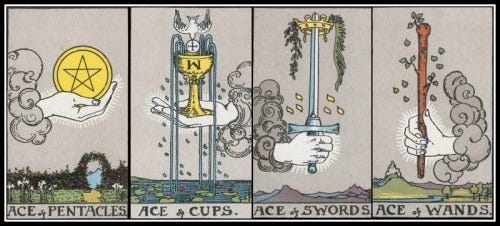
Welcome back, boos and ghouls! Last week, we stood with The Fool at the beginning of his grand, terrifying journey, mapping the archetypal milestones of the Major Arcana. Today, we descend from the ethereal heights of destiny, total consciousness, and major life themes into the mundane, yet perpetually complex, chaos of the everyday: the Minor Arcana. Just like the Major cards, the Minor cards can always be interpreted differently, so take these explanations as the consensus, but not the hard and fast rule.
The 56 cards of the Minor Arcana—the “Lesser Secrets”—are not about the fated lightning strikes of The Tower or the profound transformation of Death. They are the day-to-day struggles and triumphs that define our mortal existence. Ah, monotonous suffering, we do love you. Suppose the Major Arcana tells us why we are on a certain path (our spiritual lesson). In that case, the Minor Arcana tells us what is happening right now (the physical and emotional manifestation of that lesson).
Historically, these cards precede their illustrious Major Arcana counterparts. They are, in fact, the blueprint for the modern 52-card playing deck, originating in 15th-century Italian society as a practical tool for card games. It was the occult movement of the 18th and 19th centuries that imbued the four suits with esoteric significance, tying them irrevocably to the classical four elements and the four spheres of human life. But you already knew that, right?
The Four Pillars of the Mundane World
Each of the four suits, from the Ace (raw potential, a new beginning) to the Ten (completion, culmination), and including the four Court Cards (Pages, Knights, Queens, and Kings—representing human personalities and interactions), tells a story of conflict, growth, and resolution specific to its element.
1. Wands: The Fire of Action and Passion (Clubs)
Element: Fire
Sphere of Life: Inspiration, creativity, ambition, passion, and the initial spark of energy that drives us to act.
The Lesson: Wands deal with ideas that take off, career ambitions, and sudden bursts of growth. They are fast-moving and energetic, but their fiery nature means they can also lead to burnout or conflict born from misplaced aggression. Think of the Ace of Wands as the moment a new, brilliant idea ignites in the mind, demanding immediate action. The Three of Wands is that idea setting sail, promising future prosperity through calculated risk.
The Shadow (Reversed): When Fire is reversed, it is often smothered or out of control. A reversed Wand card can signify delay, lack of motivation, creative blocks, or aggressive, unchecked impulses. The Knight of Wands, upright, is fearless action; reversed, he is recklessness or a hasty retreat.
2. Cups: The Water of Emotion and Intuition (Hearts)
Element: Water
Sphere of Life: Feelings, intuition, relationships, love, spirituality, and the subconscious mind.
The Lesson: Cups govern the intricate, flowing world of the heart. They deal with union (Two of Cups), celebration (Three of Cups), grief (Five of Cups), and emotional fulfillment (Ten of Cups). They are the fluid, often turbulent, internal tide of our experience.
The Shadow (Reversed): The flow of Water is easily blocked or stagnant. A reversed Cup card often indicates emotional suppression, instability, heartbreak, or self-indulgence. The Seven of Cups, upright, is a dreamy contemplation of many choices; reversed, it is the painful clarity that those choices were mere illusions or fantasies, a stark awakening from a self-imposed daydream.
3. Swords: The Air of Intellect and Conflict (Spades)
Element: Air
Sphere of Life: Thought, intellect, logic, truth, communication, decisions, and mental conflict.
The Lesson: The Swords are double-edged. They represent the clear, sharp power of the mind, essential for cutting through confusion, yet they are also the source of pain, anxiety, and conflict. The most infamous card, the Ten of Swords, depicts a profound, painful ending, a total mental breakdown (been there). Yet, this finality is often necessary, representing the point where the battle is over, forcing the querent (that’s you, if you were wondering) to let go. This suit reminds us that our greatest weapon—our intellect—can also be our greatest tormentor.
The Shadow (Reversed): Air, when reversed, becomes a tempestuous, chaotic force. It indicates paralysis through overthinking, cruel communication, dishonesty, or an inability to make a necessary decision. A reversed Eight of Swords suggests a person is still mentally chained, refusing to see that the literal blindfold has been removed.
4. Pentacles: The Earth of Material and Stability (Diamonds/Coins)
Element: Earth
Sphere of Life: Material goods, finances, career, home, stability, physical health, and tangible manifestation.
The Lesson: The Pentacles deal with everything solid and substantial. They represent the fruits of our labor (so money DOES grow on trees!) and the security we build. From the raw opportunity of the Ace of Pentacles to the secure, prosperous foundation of the Nine and Ten of Pentacles, this suit chronicles our relationship with the material world. It teaches us the value of hard work, thrift, and the sensual enjoyment of the physical realm.
The Shadow (Reversed): Reversed Earth signifies instability, financial loss, greed, or excessive materialism. A reversed Pentacle card can point to a literal loss of physical security (Five of Pentacles) or a deep resistance to sharing one’s abundance, prioritizing wealth over well-being. The King of Pentacles, upright, is a successful entrepreneur; reversed, he is a figure of corruption or a man obsessed with his fortune to the detriment of his soul.
The Courtly Drama: A Cast of Human Characters
Beyond the numbered pips, the Court Cards introduce the human element. The Page is the messenger, representing new energy and curiosity. The Knight is the active force, riding in (or away) with speed and energy. The Queen is the emotional and intuitive mastery of the suit, internalized and nurturing. The King is the master, the mature, external authority figure who has fully controlled and integrated the suit’s energy into the world.
All of these minor cards combine to create a complex, yet clear projection of our current state in life, whether that state be mental, physical, or emotional. The thing about the cards, though, is that they can always change. No card is in a permanent state! They’re only a reflection of where you are in that exact moment. There are lots of tips and tricks when it comes to tarot, but the most important thing is that you take what you need from it. The phrase “if it doesn’t apply, let it fly” is one of my favorites. There are also things sometimes called “stalker cards,” which is the same card you might pull over and over in readings. Maybe it’s just luck of the draw, but maybe it’s a message that you should pay more attention to. If you keep getting an 8 of swords, it may be time to remove that blindfold and see what’s right in front of you.
The Minor Arcana is a profound system precisely because it is so relatable. It does not speak of abstract destiny but of the bills, the arguments, the parties, and the moments of profound, quiet heartbreak. It is the story of you—your daily triumphs and your nightly fears—a compelling counterpoint to the dramatic arc of the Major. Together, they provide a complex, insightful, and sometimes confusing reflection of our inner and outer worlds.
Next week, we exchange the deck for the stave as we delve into the potent and ancient secrets of the Runes and their unsettling, primal wisdom.
Until then, pay close attention to the small details of your life; that is where the Lesser Secrets truly reside.
Sources and Further Reading
Britannica. “Tarot | History, Meaning & Uses.” https://www.britannica.com/topic/tarot
V&A Museum. “A history of tarot cards.” ttps://www.vam.ac.uk/articles/tarot-cards
Science | HowStuffWorks. “Minor Arcana – Tarot Card Meanings and Symbolism.”https://science.howstuffworks.com/science-vs-myth/extrasensory-perceptions/minor-arcana-cards.htm
Gaia. “The Minor Arcana: How Numbers and Elements Give Tarot Meaning.” https://www.gaia.com/article/the-minor-arcana-how-numbers-and-elements-give-tarot-meaning
Labyrinthos. “Tarot Card Meanings List - 78 Cards By Suit, Element, and Zodiac.” https://labyrinthos.co/blogs/tarot-card-meanings-list
“It does not speak of abstract destiny but of the bills, the arguments, the parties, and the moments of profound, quiet heartbreak.”
First off, that’s just a fantastic sentence.
Second off, this feels like the sort of thing where I’ll never look at a deck of cards again after learning about this connection. Reading this forced me to realize that I’ve never once considered why the 52 cards are organized as they are, what they mean, how that structure might have originated elsewhere—I swear I’m usually more curious than that!
I like the day-to-day of the Minor. It feels horoscope-y, but less dramatically so. Perhaps my favorite observation, though, was the bit about the repeated card, if only because I don’t tend to buy deeply into Tarot like some of my friends. But that line about the 8 of swords stuck with me, stoking my superstition. If I did keep seeing the same card, in anything, the math of how unlikely that was would start to add up and get me…nervous.
Great stuff, Maddie.